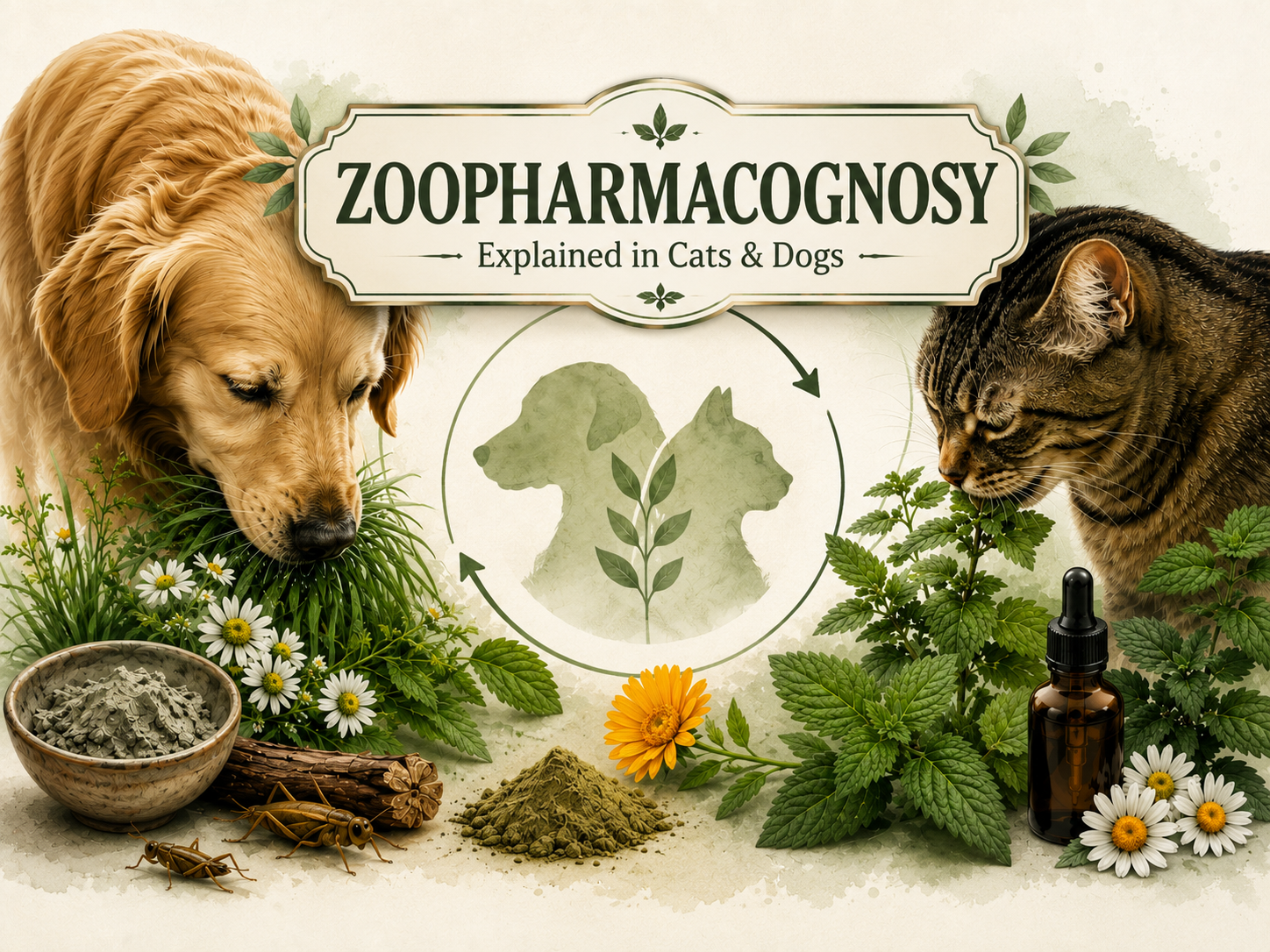
“Your dog isn’t just eating random grass. Your cat’s catnip obsession runs deeper than you think. And somewhere in an Indonesian rainforest, an orangutan just quietly redrew the history of medicine.”
The Pause That Started a Question
It happens so quietly you could miss it entirely.
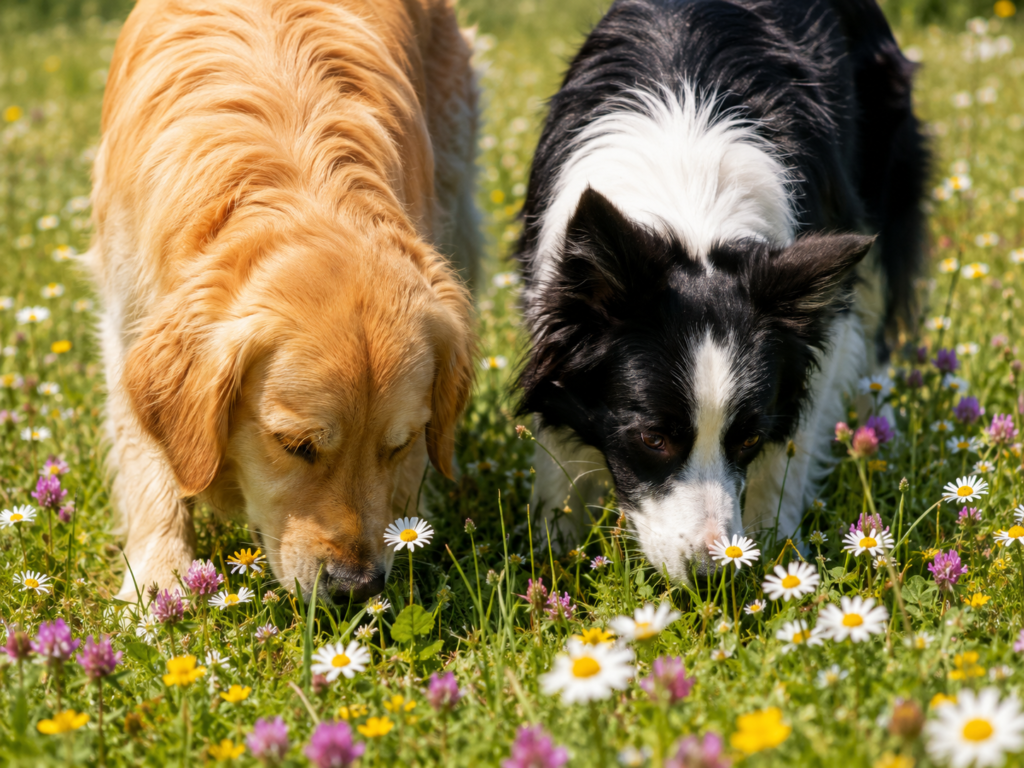
A dog trots along a familiar route, tail easy, nose skimming the air. Then, without warning, something changes. He slows beside a patch of wild grass growing against a wall—not all of it, just one particular cluster. He sniffs with the kind of deliberate attention you rarely see from him. Long, considered inhalations. Almost methodical.
Then he selects a few blades and chews them slowly before walking on, completely unperturbed.
Not panicked. Not sick-looking. Not random.
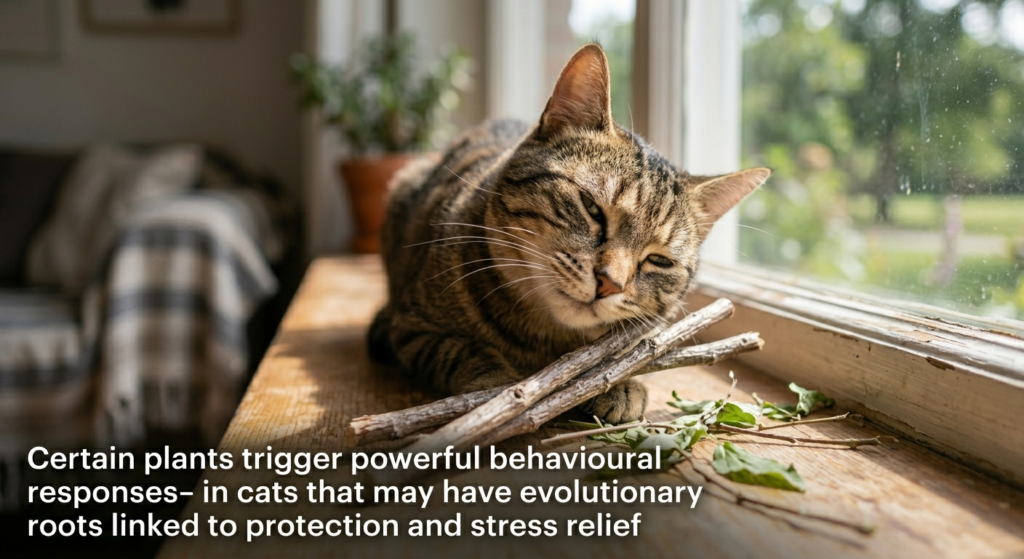
For years, most of us filed behaviours like this under “strange pet things” and kept moving. Dogs eating grass. Cats spiralling into catnip. Animals nosing at bark, rolling in aromatic herbs, seeking out particular patches of soil.
Odd little quirks. Harmless. Inexplicable.
Except they might not be inexplicable at all.
A Word With Ancient Roots
The science of animal self-medication has a name that sounds more complicated than it is: zoopharmacognosy. Break it open and the meaning becomes beautifully simple.
Zoo — animal. Pharma — medicine. Cognosy — knowing.
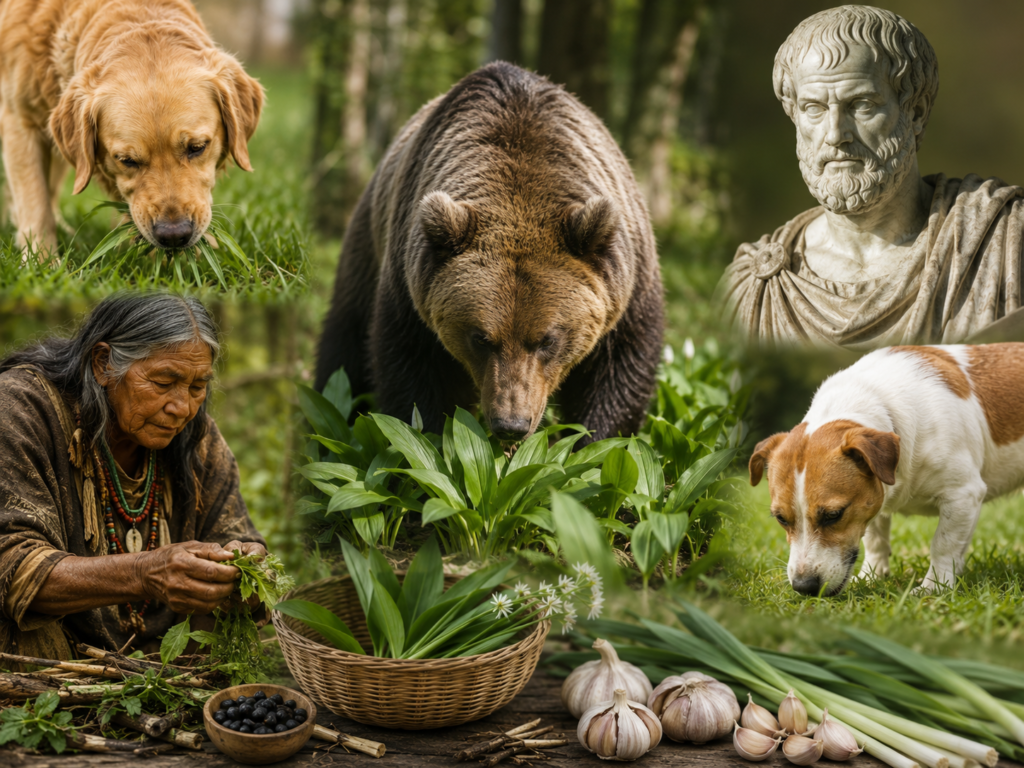
The term was formally coined in 1987, but the observation it describes is far older. Aristotle documented dogs eating grass to purge intestinal parasites. He also noted that after hibernation, bears seek wild garlic as their very first food — a plant rich in vitamin C, iron, and magnesium: precisely the nutrients depleted after a long winter fast. The Roman naturalist Pliny recorded similar patterns two thousand years ago. And Indigenous peoples across the world, for generations, learned which plants had medicinal value not from books, but by watching which plants sick animals chose to seek out.
Modern medicine has inherited more from animals than it usually acknowledges.
For decades, zoopharmacognosy lived on the edges of mainstream science — too anecdotal to defend easily, too easy to romanticise, too difficult to study under controlled conditions. Then something happened in an Indonesian rainforest that made it very hard to look away.
The Day Rakus Rewrote History
Rakus is a large male Sumatran orangutan. Flanged, dominant, believed to have been born around 1989. He lives in the protected peat swamp forests of Gunung Leuser National Park, Indonesia, where researchers from the Max Planck Institute of Animal Behavior have been observing the local population for over twenty years.
In June 2022, Rakus appeared with a fresh open wound on his right cheek — likely the result of a fight with another male. The team noted it and continued their observations.
Three days later, they watched Rakus do something no scientist had ever systematically documented a wild animal doing before.
He moved through the forest to a specific climbing vine called Akar Kuning — Fibraurea tinctoria in Latin, or “yellow root” in English. This plant is rarely consumed by orangutans in this forest. Of the 132 animals in the study population, only a small fraction had ever been observed eating it at all.
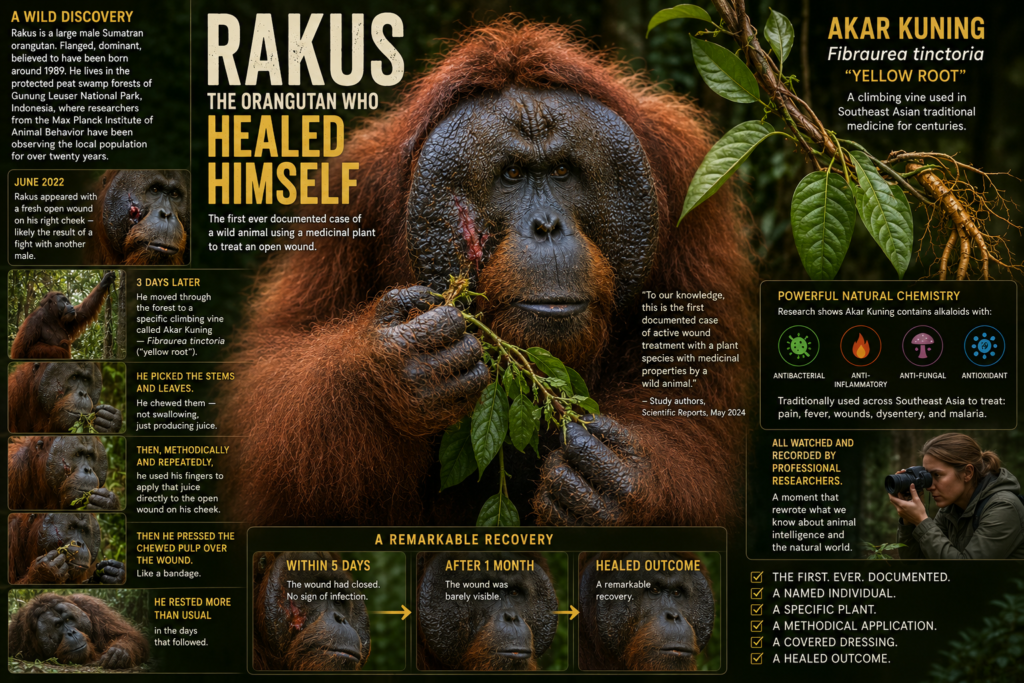
Rakus picked the stems and leaves. He chewed them — not swallowing, just producing juice. Then, methodically and repeatedly, he used his fingers to apply that juice directly to the open wound on his cheek.
Then he pressed the chewed pulp over the wound. Like a bandage.
He rested more than usual in the days that followed.
Within five days, the wound had closed. After one month, it was barely visible. No sign of infection. None.
Research on Akar Kuning’s chemistry shows the presence of alkaloids with antibacterial, anti-inflammatory, anti-fungal, and antioxidant properties. The same plant is used across Southeast Asia in traditional medicine to treat pain, fever, wounds, dysentery, and malaria.
“To our knowledge, this is the first documented case of active wound treatment with a plant species with medicinal properties by a wild animal,” wrote the study authors in Scientific Reports, published May 2024.
The first. Ever. Documented. A named individual. A specific plant. A methodical application. A covered dressing. A healed outcome. All watched and recorded by professional researchers.
Zoopharmacognosy had its landmark moment.

The Chimps Who Treat Each Other
Rakus was extraordinary. But he was not alone.
Two years earlier, in Gabon’s Loango National Park, primatologist Simone Pika was reviewing footage from the Ozouga Chimpanzee Project when she noticed something that made her stop the playback entirely.
A female chimpanzee named Suzee was examining a wound on her adolescent son’s foot. She paused, looking around. Then she reached out, caught a tiny flying insect from the air, held it briefly between her lips, and carefully pressed it onto the open wound. Almost like a mother applying a plaster to a scraped knee.
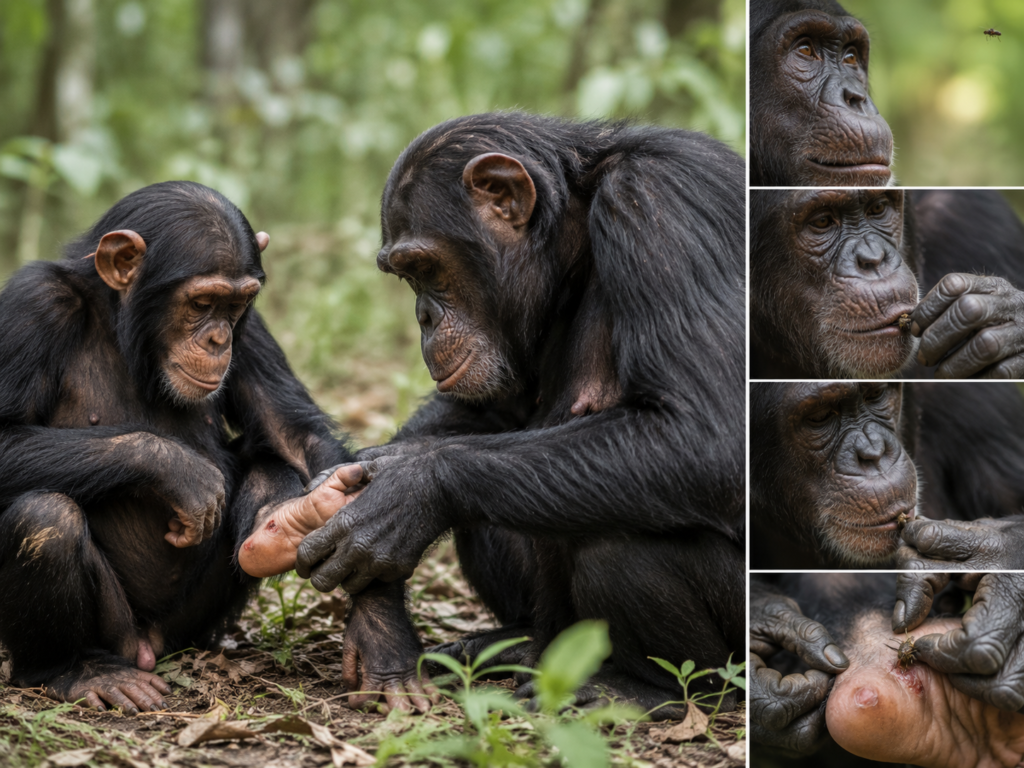
She was not eating the insect. She was using it.
Over fifteen months, the research team catalogued 76 separate cases of chimpanzees using insects this way — on their own wounds and, in some remarkable instances, on the wounds of other group members. Chimpanzees actively caring for each other’s injuries.
By 2025, the same behaviour had been documented in a second, entirely separate chimpanzee community in Uganda’s Kibale National Park — suggesting this isn’t a quirk of one group, but a pattern that has independently emerged, or quietly spread, across populations.
What precisely is in those insects? Scientists don’t yet know for certain. Whether the effect is antibacterial, anti-inflammatory, or something else entirely is still under investigation.
But multiple chimpanzee communities, in different countries, catching flying insects and pressing them deliberately onto wounds with targeted, repeated behaviour?
That is not coincidence. That is a pattern.
A Cabinet Stocked Across the Animal Kingdom
The scope of documented zoopharmacognosy stretches far beyond primates.
African elephants have been observed travelling significant distances to specific trees in the days before giving birth — seeking out leaves that local Kenyan communities have long used in traditional medicine for exactly the same purpose of encouraging labour. The same plant. The same timing. Researchers discovered the overlap with considerable astonishment.
Parrots in the Amazon consume mineral-rich clay from riverbanks after feeding on seeds containing toxic compounds. The clay appears to bind those toxins in the digestive tract, reducing their absorption. These birds are not eating clay for nutrition. They are neutralising a meal that would otherwise harm them.
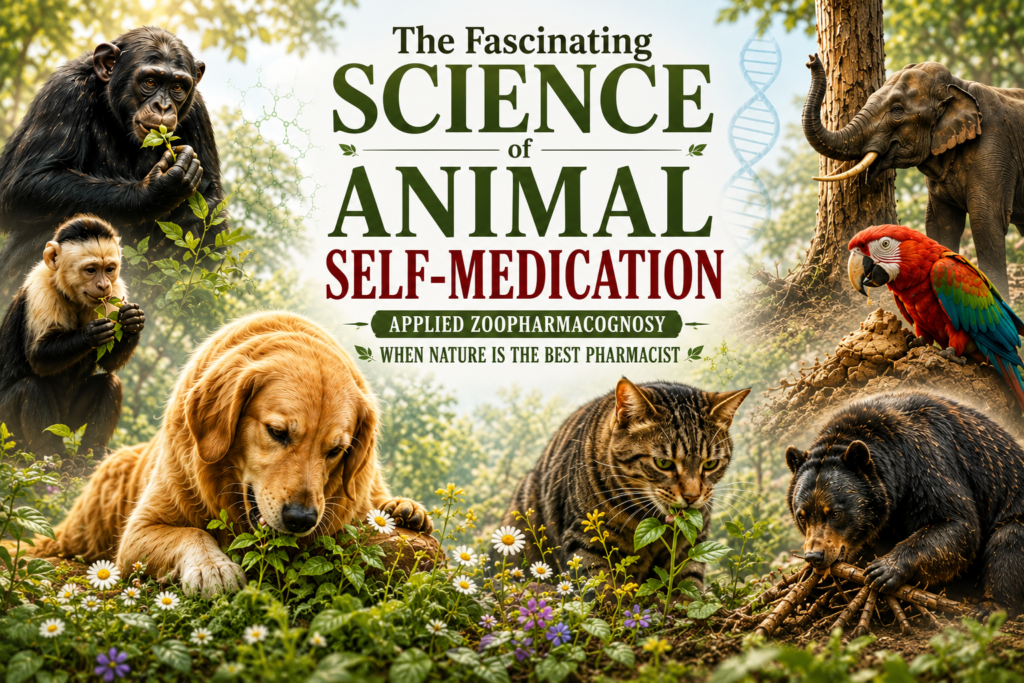
Capuchin monkeys rub crushed citrus rinds, aromatic plants, and in one particularly striking case, millipedes — onto their own fur and the fur of their troop members. The compounds released appear to deter biting insects and offer parasitic protection. This is not self-grooming. This is a community applying insect repellent.
Wild bears have been observed chewing specific medicinal roots into a thick paste and rubbing them across their bodies. Some of those same roots appear in traditional herbal medicine associated with anti-inflammatory support.
Monarch butterflies select milkweed containing compounds called cardenolides when laying their eggs. When infected with a parasite, monarchs preferentially choose the more chemically potent varieties. The sicker they are, the more specifically medicinal their choice becomes.
No one is suggesting these animals understand organic chemistry.
But they are doing something that reliably, repeatedly, and consistently works. And evolution does not sustain behaviours that cost energy and deliver nothing in return.
The Animals You Share Your Home With
All of this matters for the animals sleeping on our sofas.
Dogs remain one of the most observed and still most misunderstood examples in this space. The grass-eating question has generated significant research, and the simplified answer — “dogs eat grass to make themselves sick” — turns out to be mostly wrong. Most dogs who eat grass are not ill beforehand. Most do not vomit afterward. And many display clear selectivity: returning to specific grass types, ignoring others nearby, choosing with more care than the “random impulse” theory would ever suggest.
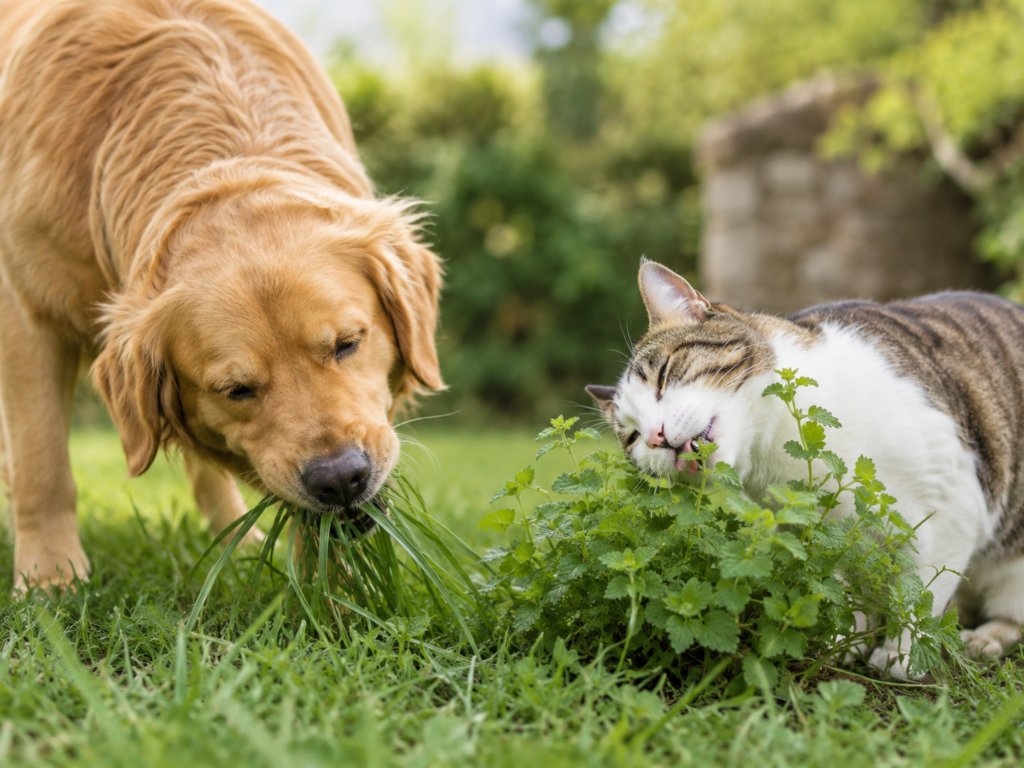
In applied zoopharmacognosy sessions — a wellness practice where animals are offered safe natural substances and allowed to choose freely — dogs sometimes show persistent, preference-based behaviour. Some consistently lean toward calming herbs during stressful periods. Some select more stimulating scents when lethargic. Some engage intently with one plant while completely ignoring its neighbour. Nothing is forced. The animal chooses. Or declines.
Cats are, if anything, even more chemically sensitive.
Most people treat catnip as purely recreational — a plant that makes cats briefly delightful and irrational. But a Japanese research study found something more layered: when cats rolled in silver vine, they coated their fur with compounds scientifically shown to repel mosquitoes. What looked like blissful self-indulgence may also be sophisticated, instinct-driven insect defence.
One cat becomes boneless and blissful around valerian. Another ignores it completely. One dog is transfixed by chamomile; another walks past without a second glance. Individual variation here, as in humans, is real. Our animals are not interchangeable. Their biology is personal, contextual, and shifting.
Applied Zoopharmacognosy: What It Actually Looks Like
As research in this area has grown, a gentle wellness practice has developed around it.
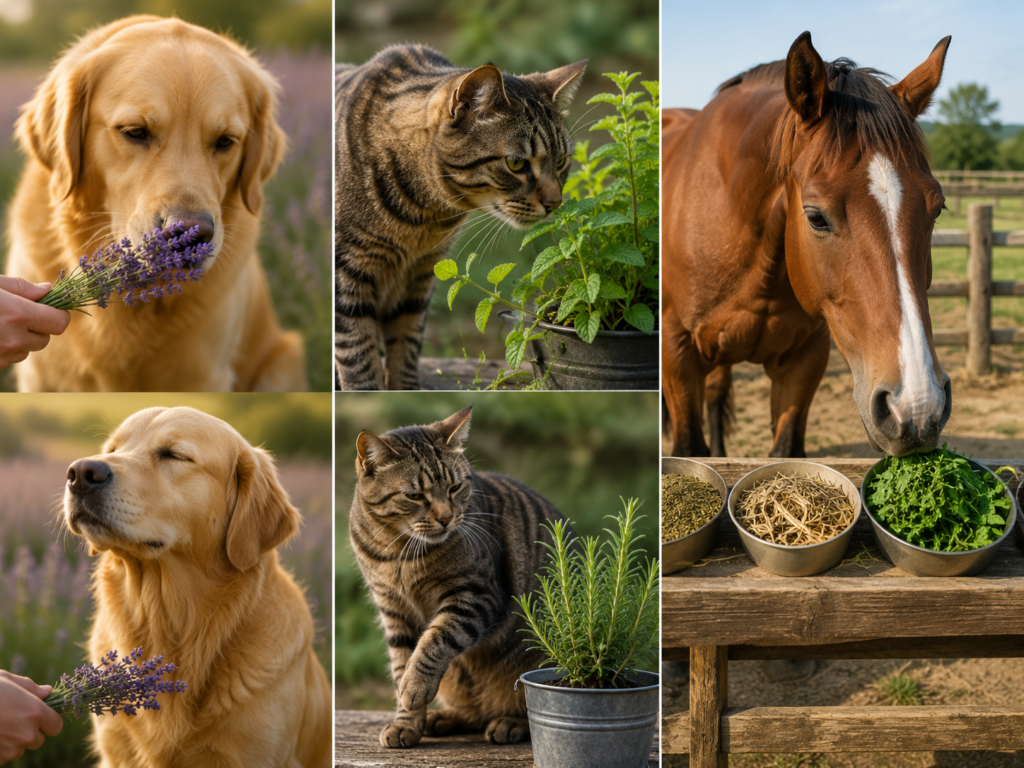
A practitioner presents safe, carefully selected herbs, dried plant material, hydrosols, clays, or diluted essential oils — one at a time. The animal is never restrained. Never guided toward a substance. Never assumed to want something because it has been theorised to help them.
The observation is the whole point.
A dog who leans visibly toward a particular scent and visibly relaxes. A cat who investigates one herb with focus while turning immediately away from another. A horse who makes a choice that surprises everyone in the room. Supporters believe these responses reflect genuine biological self-selection — an animal reading its own body and responding. Critics argue that interpretation can slide toward subjectivity. Both are right.
What responsible practitioners consistently agree on: applied zoopharmacognosy should never replace veterinary diagnosis or treatment. Essential oils are particularly dangerous for cats when used incorrectly — what smells pleasant to us can be toxic to them. And if an animal disengages, that is the answer. You stop.
For curious pet owners, the entry point is simple. Offer a small amount of dried chamomile to a dog to sniff. Introduce cat-safe silver vine. Observe without expectation. Let the animal decide. Note what you see. And consult your vet for any sign of actual illness, pain, vomiting, or behavioural change — always, without exception.
Sometimes what you learn is dramatic. Often what you gain is simply this: you watched your animal with real, undivided attention for a while. In a world of scrolling and rushing, that too is not nothing.
Why This Matters If You Think About What Animals Eat
I’ll speak from where I stand.
Those of us who have spent years in the raw feeding world think a great deal about what animals evolved to eat, what their bodies are built to process, and what decades of industrial pet food production has quietly stripped away from their biology. We think about instinct. We think about what a dog or cat would seek out in a less processed, less mediated world.
Zoopharmacognosy sits directly inside that conversation.
A body that knows how to select the right protein also has the capacity to recognise the right plant. A dog whose immune system runs on evolutionary programming didn’t lose all of that programming when it moved indoors. The behaviour is still there, surfacing in grass-eating, in soil-sniffing, in the persistent fascination some animals show toward specific textures and scents that to us seem arbitrary.
Domestication compressed many of those channels. It did not close them.
Where Science Stands — And Where It’s Headed
Zoopharmacognosy is no longer fringe science. It appears in Scientific Reports, Current Biology, PNAS, and Nature. It is the subject of doctoral research, pharmaceutical interest, and conservation studies. Because animals may, quite literally, have already done some of the drug discovery work for us. The anti-parasitic compounds in the plants chimpanzees use. The antibacterial alkaloids in Rakus’s yellow root. These are not mythological remedies. They are chemically active substances that work.
But the story is not finished, and the best people in this space say so plainly.
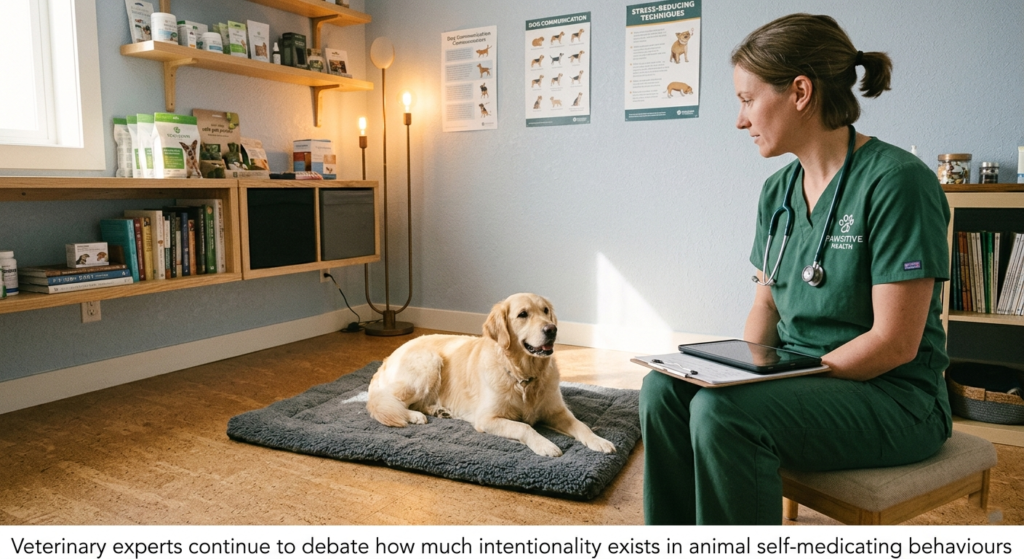
Veterinary opinion remains measured. Wildlife research produces increasingly compelling data. Evidence around domestic pets is still developing. The challenge of interpretation — distinguishing genuine self-selection from simple novelty response, avoiding the comfortable human habit of projecting too much intention onto animal behaviour — is real and ongoing.
The best integrative veterinarians occupy a thoughtful position: be curious, observe carefully, do not romanticise. Respect instinct. Do not replace medicine with it.
The science of Rakus applying a poultice to his own face in a rainforest — and healing without infection — is not romance. It is peer-reviewed data. What it tells us about the intelligence threaded through animal bodies, and how much we have yet to understand, is a conversation that will run for decades.
The Animal Watching You
The next time your dog pauses on a walk beside a specific patch of grass, something about your response might shift.
Not because dogs possess magical healing powers. Not because every mouthful of grass is medicine. Not because your cat melting into a cloud of silver vine is the same as an orangutan in a rainforest methodically dressing a wound.
But somewhere between the dismissal and the over-eager interpretation, there is a more interesting truth.
Your animal is reading the world constantly. Through scent, texture, chemistry, temperature, and instinct. Gathering information from everything it touches. Responding to signals from inside its own body that it cannot name but still, quietly, answers.
Millions of years of evolutionary pressure built that system.
Modern life quieted it. But did not silence it.
What remains is still running. Still searching. Still worth paying attention to.
Author – Sylvia Lakshmanan is Pet Food Industry Specialist & Brand Consultant
About The Author