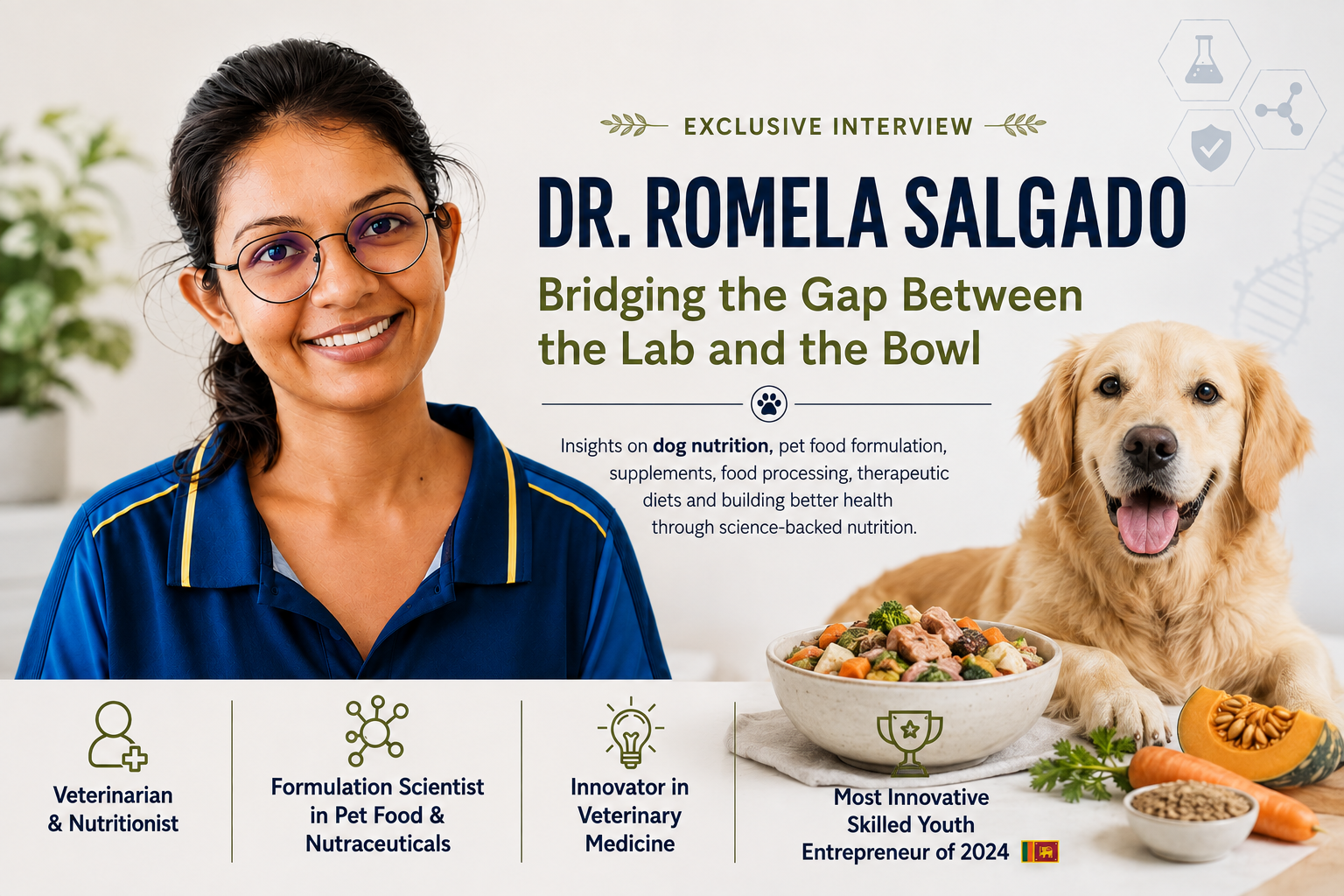
Dr. Romela Salgado is a veterinarian, pet nutritionist, formulation scientist, and veterinary medicine innovator from Sri Lanka, with eight years of clinical experience in companion-animal medicine. Through Pet Labs®, she works at the intersection of veterinary science, nutrition, nutraceutical formulation, and pet-food product development, helping brands transform ideas into scientifically grounded products.
She is also the founder of Spotz, Sri Lanka’s first functional fresh pet-food line, and was recognized nationally as the Most Innovative Skilled Youth Entrepreneur of 2024 for her work with Pet Labs.
In this exclusive Edupet interview, “Bridging the Gap Between the Lab and the Bowl,” Dr. Romela Salgado takes us beyond the marketing claims on pet-food packs and into the science behind formulation, nutrient bioavailability, food processing, home-prepared diets, nutraceuticals, therapeutic nutrition, quality control, and the unique challenges of developing pet-food products for tropical markets such as India and Sri Lanka.
Edupet is pleased to bring you this insightful conversation with Dr. Romela Salgado.
1. For a pet parent trying to choose the best food, ingredient decks can be incredibly misleading. Beyond basic protein percentages, what are two or three specific “red flags” on a label—such as ingredient splitting or vague terminology—that indicate a product prioritizes marketing appeal over metabolic function?
Dr. Romela: The first red flag is when the label gives you a beautiful ingredient story but very little evidence of nutritional adequacy. Words such as “holistic,” “premium,” “natural,” or “superfood” can sound impressive, but they do not tell you whether the finished food actually delivers the required nutrients in appropriate amounts or whether those nutrients are bioavailable. Even WSAVA cautions that ingredient lists can be misleading and recommends looking beyond the ingredient panel to formulation expertise, quality control, nutritional analysis and research.
Second, I look for ingredient splitting. If several forms of a similar carbohydrate appear separately—such as peas, pea protein, pea starch and pea fibre, the list can make the primary ingredients look more animal-protein-heavy than the overall formulation really is. The ingredient list is organized by weight before processing, so it is not a nutritional analysis of what the dog ultimately receives.
Third, I become cautious when a company is extremely specific about the glamorous ingredients but vague about the fundamentals. “With turmeric, blueberries, salmon oil and ancient grains” tells me much less than knowing the food’s caloric density, complete-and-balanced status, nutrient specifications, quality-control program and whether the manufacturer can provide an actual typical nutrient analysis.
Ultimately, I don’t formulate from the front of the packet; I formulate from the nutrient profile of the finished food. That distinction is fundamental.
2. In India, many pet parents prepare fresh home-cooked meals believing it is inherently healthier than commercial kibble. From a clinical standpoint, what are the most common “invisible” micronutrient imbalances you see in dogs fed long-term, unformulated home-cooked diets?
Dr. Romela : The biggest misconception is that a meal can be wholesome without being nutritionally complete. Chicken, rice, vegetables, eggs and perhaps some organ meat can look exceptionally healthy in a bowl and still fail to meet a dog’s requirements.
The most common problems involve calcium-to-phosphorus balance and trace minerals, together with nutrients such as zinc, copper, iodine, vitamin D, Manganese, vitamin E and certain B vitamins. Potassium can also be inadequate depending on the recipe. A published analysis of 75 home-prepared canine diets found that none supplied all of the evaluated nutrients at recommended levels, and more than 84% were deficient in at least three nutrients. Calcium and potassium were among the most frequent deficiencies in the dog recipes studied.
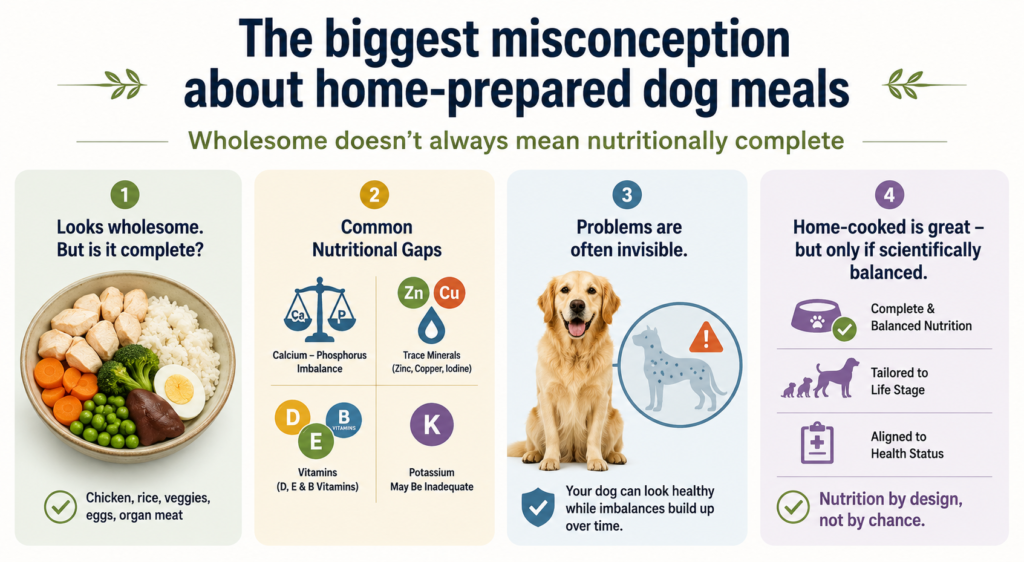
The other issue is that some deficiencies don’t announce themselves immediately. A dog can maintain appetite, have a shiny coat and appear perfectly happy while its diet is gradually creating a mineral or micronutrient imbalance.
So I am not against home cooking. I am against improvising a long-term home-prepared diet without formulation. If somebody wants to feed fresh food, wonderful but the recipe should be designed around nutrient requirements, energy density, digestibility and the individual dog’s life stage and health status, rather than around a list of ingredients that simply sounds healthy.
3. For a pet parent deciding between extruded kibble, gently cooked, and raw/fresh diets, how do you explain the impact of high-heat processing on protein denaturation, digestive enzyme demand, and long-term gut microbiome diversity?
Dr. Romela : I would first remove one common misconception: protein denaturation is not automatically bad. Cooking unfolds proteins and can actually make them easier for digestive enzymes to access. The problem arises when heat processing is sufficiently intense or prolonged to cause undesirable chemical reactions, particularly Maillard reactions, which can reduce the availability of certain amino acids such as lysine.
I also would not tell pet parents that kibble inherently “overworks” the pancreas or that raw food automatically creates a superior microbiome. Those statements go beyond the evidence.
Processing absolutely changes the food matrix, however, and studies in dogs show that different formats can produce measurable differences in digestibility, fecal characteristics, metabolites and microbial communities. A recent controlled study comparing extruded, fresh, frozen-raw and freeze-dried diets found significant differences in nutrient digestibility and microbiota, but the researchers also emphasized that ingredient composition and processing are difficult to separate and that more research is needed.
So my question is not simply, “Was this food heated?” My question is: What happened to the nutrients during processing, and what does the finished product actually deliver?
And with raw diets, there is another consideration that cannot be ignored: microbial safety. Minimally processed does not automatically mean biologically safer.
4. Pet parents frequently add fish oil, joint chews, probiotics, and trending superfoods like turmeric or ashwagandha to their dog’s daily bowl. How can an owner tell if they are creating nutrient antagonism, absorption conflicts, or unnecessary organ strain by stacking too many supplements?
Dr. Romela : I use a very simple principle: every supplement should have a reason, a dose, a duration and a measurable objective.
The danger is not usually that one supplement is inherently “bad.” It is that owners can unknowingly stack overlapping nutrients. A complete diet may already contain adequate levels of certain vitamins and minerals, and adding multiple products can push total intake well beyond what was intended. Fat-soluble vitamins are particularly important because the body handles them differently from water-soluble vitamins.
There can also be formulation-level interactions. Minerals compete for absorption; some fibres and plant compounds can alter mineral availability; excessive calcium can interfere with the utilization of other minerals; and certain supplements can alter gastrointestinal function or interact with medications.
Fish oil is another good example: the question isn’t simply “Does my dog need omega-3?” It is how much EPA and DHA is already being consumed, what is the purpose, how stable is the oil, and is the formulation adequately protected against oxidation?
For an owner, I would recommend maintaining a complete list of everything the dog consumes including treats, chews, powders, oils and human supplements, and having a veterinary nutritionist review the total intake. The goal should be precision, not supplement accumulation.
5. You often emphasize that dietary damage is “slow, cumulative, and silent.” Beyond obvious signs like vomiting or diarrhea, what subtle everyday signals—such as coat texture, energy crashes, or stool volume—indicate to an owner that a diet is failing their dog at a cellular level?
Dr. Romela : I would be careful with the phrase “at a cellular level.” There is no single home-observable sign that proves cellular nutritional damage.
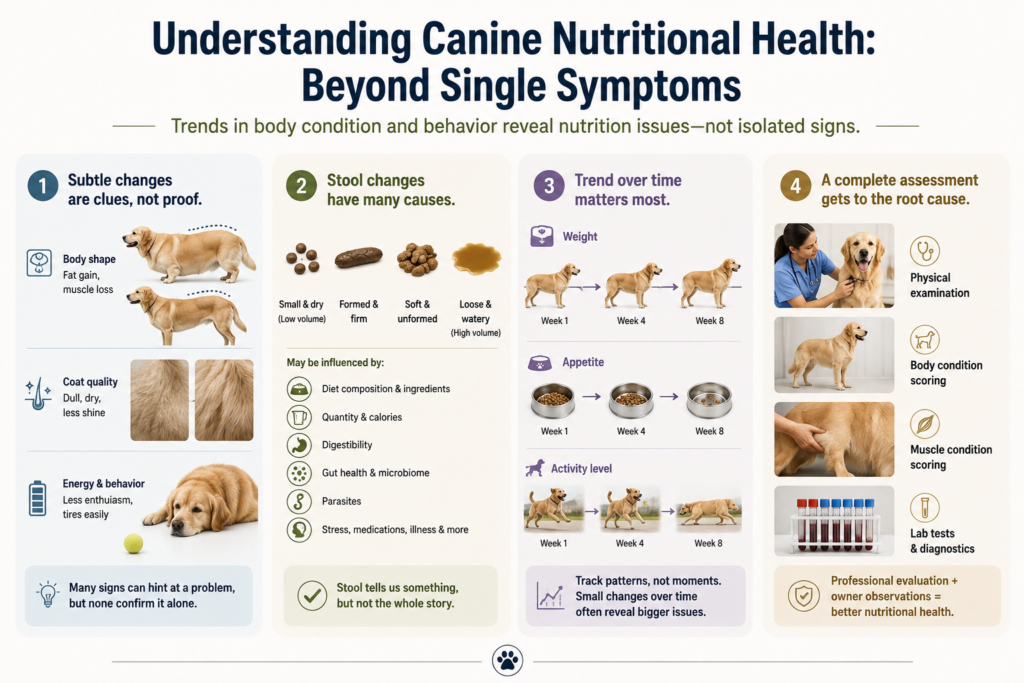
What owners can observe are patterns. Changes in body condition, unexplained weight gain or loss, declining muscle mass, reduced exercise tolerance, persistent changes in stool volume or consistency, excessive stool production, recurrent gastrointestinal upset, changes in coat quality, altered appetite or unusual fluctuations in energy can all be useful clues.
But none of these signs is diagnostic by itself. A dull coat, for example, can result from nutrition, parasites, endocrine disease, dermatological disease or many other conditions. Likewise, large stool volume may reflect fibre content, digestibility or simply feeding quantity.
The important concept is trend rather than snapshot. If a dog has gradually gained fat while losing muscle, develops increasingly inconsistent stools, drinks more water, becomes less enthusiastic about exercise or shows persistent changes in appetite, that deserves investigation.
Nutrition should therefore be assessed alongside physical examination, body condition scoring, muscle condition scoring and appropriate laboratory testing, not by looking at the stool or coat in isolation.
6. With the market rapidly diversifying into extruded, air-dried, freeze-dried, and commercial raw formats, how does the physical “food matrix” alter the bioavailability of synthetic vitamin premixes versus whole-food nutrients?
Dr. Romela : This is where nutrition becomes much more sophisticated than simply asking whether a nutrient is “natural” or “synthetic.”
The food matrix determines how nutrients are physically and chemically presented to the digestive system. Processing can alter particle size, starch gelatinization, protein structure, fat distribution, moisture and interactions between nutrients and other food components. These changes can influence digestibility and absorption.
A synthetic nutrient added to a formulation is not automatically poorly absorbed, and a nutrient present in a whole food is not automatically highly bioavailable. In fact, whole food can contain compounds that enhance absorption in some circumstances and inhibit it in others.
The correct question is therefore: What is the bioavailable nutrient contribution of the finished formulation?
That is why formulation should be validated at the finished-product level rather than assuming that an ingredient database tells the entire story. Current nutritional guidelines, such as the 2025 FEDIAF guidelines, are designed precisely to help manufacturers formulate complete foods around nutrient requirements rather than relying on ingredient mythology.
7. For DVMs seeing a surge in canine obesity, IBD, and early-stage renal issues, what are the subtle, early metabolic markers that signal a commercial diet is quietly failing a dog before it becomes a full-blown chronic illness?
Dr. Romela : I would change the wording slightly: we should not assume that a commercial diet is “quietly failing” simply because a dog develops obesity, gastrointestinal disease or renal abnormalities. Those conditions are multifactorial.
What we should be looking for are early deviations from the individual dog’s healthy baseline.
For obesity, body condition score, muscle-condition score, weight trajectory and caloric intake are often more informative initially than a single blood value. For gastrointestinal disease, persistent stool changes, appetite changes, weight loss and serum markers interpreted alongside clinical history can prompt further investigation.
For renal health, trends in creatinine, SDMA, urinalysis including urine specific gravity and other appropriate renal assessments can identify problems earlier than waiting for overt clinical signs. The important word is trend. One laboratory result rarely tells the whole story.
A nutritionally responsible veterinarian asks: Is the diet appropriate for this dog’s life stage and disease risk? Is the caloric intake appropriate? Are nutrients being supplied in appropriate amounts? Is the dog digesting and tolerating the food? And is there evidence that the animal’s physiology is changing over time?
That is a much more scientifically defensible approach than blaming a particular processing method or ingredient category.
8. When formulating a complex nutraceutical (like a joint or gut health matrix), how do you select the delivery system—powder, liquid, or cold-pressed chew—to ensure the active compounds survive the canine gastric acid and actually reach the target tissue?
Dr. Romela : For each active ingredient, I ask a set of questions that help me choose the ideal ones
For probiotics, for example, viability is a central issue. It isn’t enough to put a large number on the front of the package; the relevant question is how many viable organisms remain through the product’s shelf life and under the stated storage conditions.
For joint ingredients, what matters is whether the compound or its active metabolites are absorbed at a biologically meaningful dose.
So powder, liquid and chew are not inherently better or worse. The delivery system should be selected according to the chemistry of the active, its stability requirements, the manufacturing process and the intended biological outcome.
9. As advocates for biologically appropriate diets, we often push for minimally processed foods. Yet, regulatory bodies frequently necessitate heavy synthetic supplementation just to meet standardized minimums. How do you scientifically balance the desire for a whole-food, bioavailable diet with the rigid box-ticking of global regulatory frameworks?
Dr. Romela : I don’t see regulation and whole-food nutrition as enemies. I see them as two different layers of the same problem.
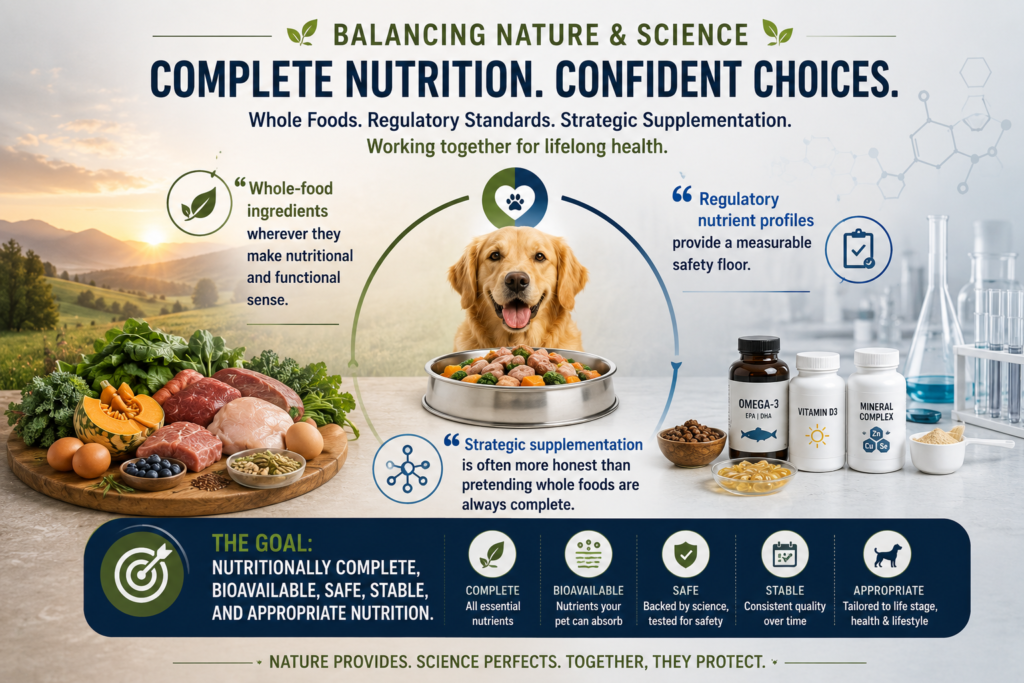
A biologically attractive ingredient does not guarantee a nutritionally complete diet. Regulatory nutrient profiles give us a measurable safety floor: they tell us that the finished food must provide appropriate amounts of essential nutrients for the intended species and life stage. FEDIAF, for example, publishes detailed nutritional guidelines for complete and complementary food, while AAFCO provides nutrient profiles and related frameworks in North America.
The challenge is to use whole-food ingredients wherever they make nutritional and functional sense while using purified or supplemental nutrients where the natural ingredients cannot reliably provide the required amount.
I would actually argue that strategic supplementation is often more honest than pretending that a bowl of whole foods is nutritionally complete simply because every ingredient is recognizable.
The goal is not “natural at all costs.” The goal is nutritionally complete, bioavailable, safe, stable and appropriate for the animal.
10. India and Sri Lanka share challenging tropical climates with high heat and humidity. What are the silent formulation failures entrepreneurs face when they adapt Western formulations without adjusting for our unique supply chain and environmental stressors?
Dr. Romela : A formulation that performs beautifully in a temperate, low-humidity environment can behave very differently in a tropical supply chain. The major risks include moisture migration, elevated water activity, lipid oxidation, vitamin degradation, packaging failure, caking, microbial growth and accelerated loss of potency.
The problem becomes even more complicated when the product moves through warehouses, transport vehicles, retail stores and consumers’ homes, because the temperature and humidity history may be very different from the controlled conditions used during product development.
Entrepreneurs sometimes validate the recipe but fail to validate the product’s entire environmental life cycle.
That means looking at packaging-barrier properties, oxygen exposure, moisture transmission, antioxidant strategy, water activity where applicable, microbial stability, accelerated and real-time shelf-life studies, and what happens after the package is opened.
In tropical markets, shelf life is not simply a number printed on the packet. It is a formulation, packaging and supply-chain engineering problem.
11. Transitioning from general wellness to therapeutic diets requires immense precision. However, many regional brands struggle with consistent raw material sourcing. How do you engineer “tolerance for variance” in a formulation when ingredient consistency cannot be 100% guaranteed by local suppliers?
Dr. Romela : You cannot engineer away variability; you have to design for it and measure it.
The first step is establishing specifications for every critical raw material not merely “chicken” or “rice,” but acceptable ranges for moisture, protein, fat, ash, fibre and other relevant parameters. Depending on the ingredient, you may also need specifications to maintain quality and quantity
This becomes even more important for therapeutic diets. A maintenance food may tolerate a little more formulation variability than a diet designed around a narrow therapeutic nutrient target.
In other words, formulation is not a recipe; it is a controlled system.
12. For an emerging pet food startup wanting to transition their concept from a “kitchen recipe” to a commercial scale, what is the very first scientific stress-test they should subject their formula to before they even think about investing in manufacturing?
Dr. Romela : The first test should be a nutritional feasibility and robustness assessment of the formulation, not a taste test and not a manufacturing trial.
Then stress-test the formula against realistic ingredient variability.
Only once the formula survives that exercise should you move into pilot manufacturing, palatability, digestibility, stability, packaging and shelf-life testing.
And there is one more critical point: the formulation must eventually be verified analytically on the finished product. WSAVA’s guidance specifically emphasizes ingredient validation, finished-diet nutrient analysis, toxicology, bacteriology and packaging/shelf-life assessment as components of responsible pet-food quality control.
A kitchen recipe tells you what you intend to make.
A validated formulation tells you what the animal will actually receive.
About The Author